
Support at your height.
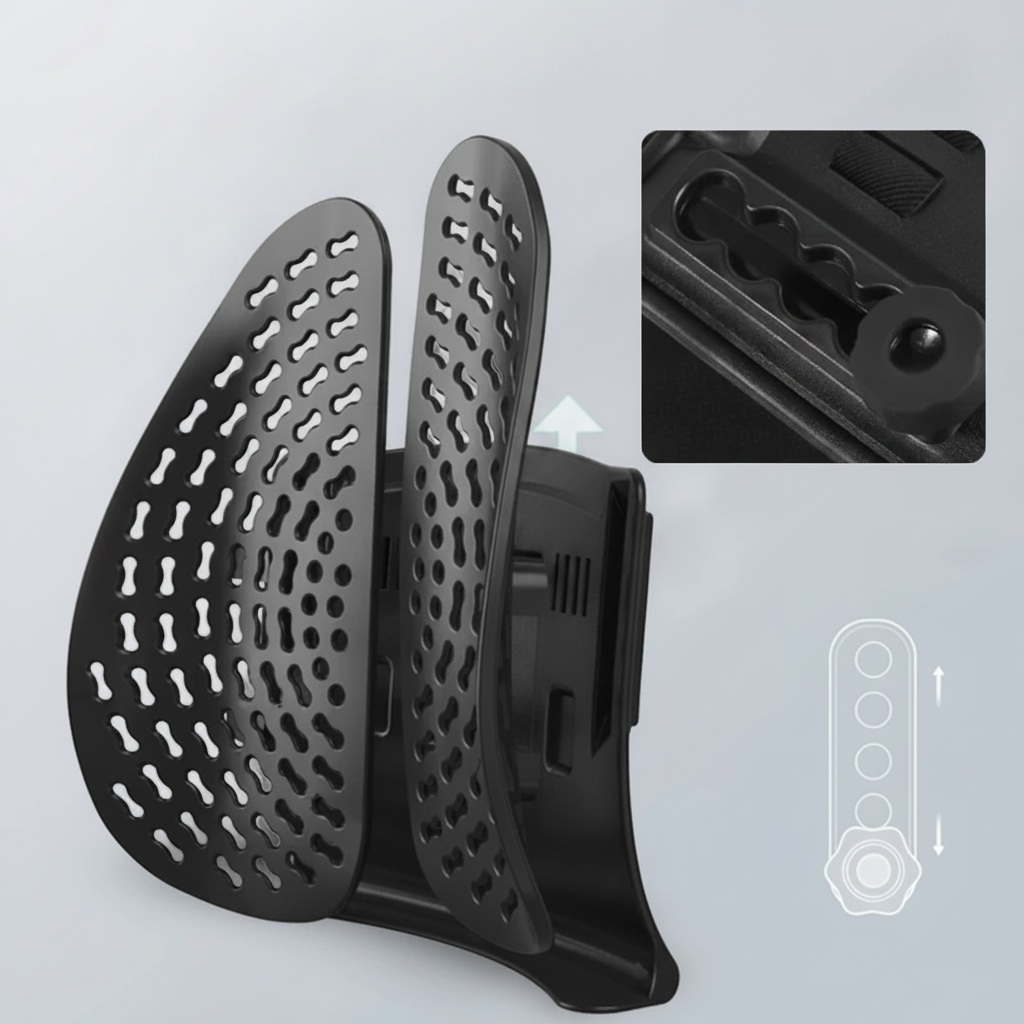
Four positions, tool free. Set the curve where your back actually bends.
- Four locked height positions, no tools
- Twin wings over an open centre channel
- Perforated shell, no foam core
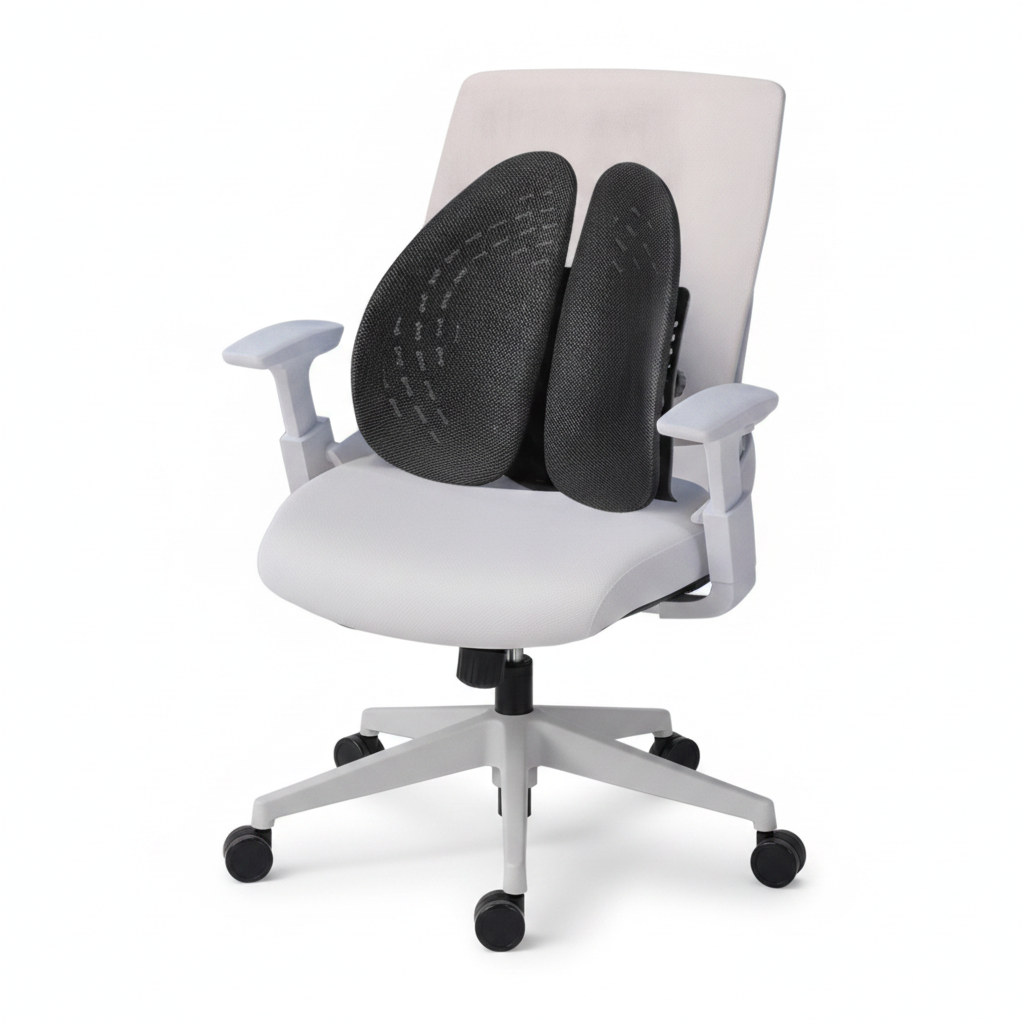
Built around one complaint we found in thousands of reviews: the support never lands where your back actually curves.
Your chair supports a back. It does not support yours.
Backrests are built to one curve, and it is roughly the curve of a 5 foot 10 inch adult. If your torso is shorter than that, the support lands up around your ribs and pushes your shoulders forward. If it is longer, the support lands on your pelvis and does nothing at all. Either way you spend the day quietly bracing against it, and by three in the afternoon you have that dull ache low in your back and you are getting up every twenty minutes to walk it off.
A cushion with a fixed apex is just a second chair that does not fit you.
So most people buy a cushion. And most cushions have a fixed apex too, so it becomes the same problem in a new shape, usually thicker, which pushes you forward until your upper back no longer touches the chair. Now nothing fits. That is the loop this product was designed to break.
The support has to meet the curve. So the curve is what we made adjustable.
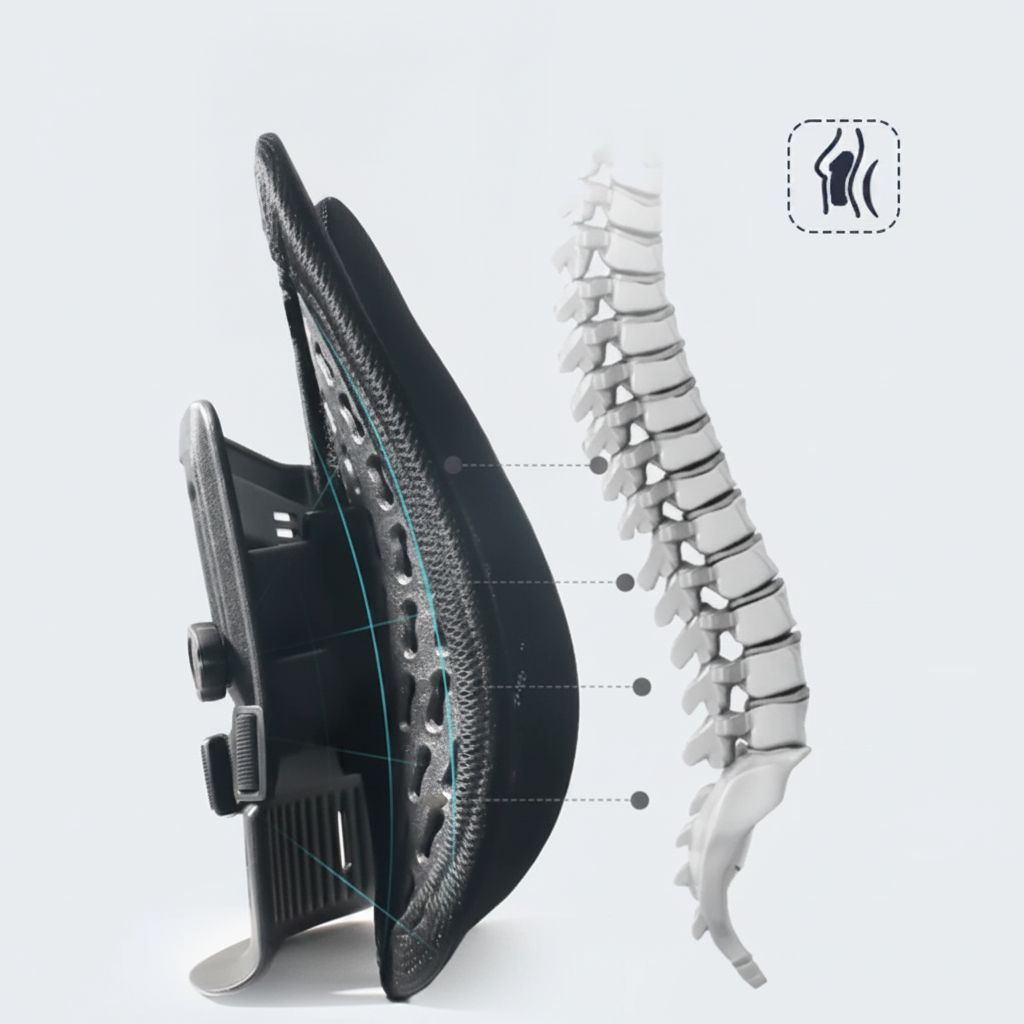
Your lumbar curve peaks somewhere between the top of your pelvis and the bottom of your ribs. Where exactly depends on your torso, not your height, which is why two people the same height need the support in two different places. Uprite moves through four locked positions so the apex sits on your curve, and the strap holds it there.
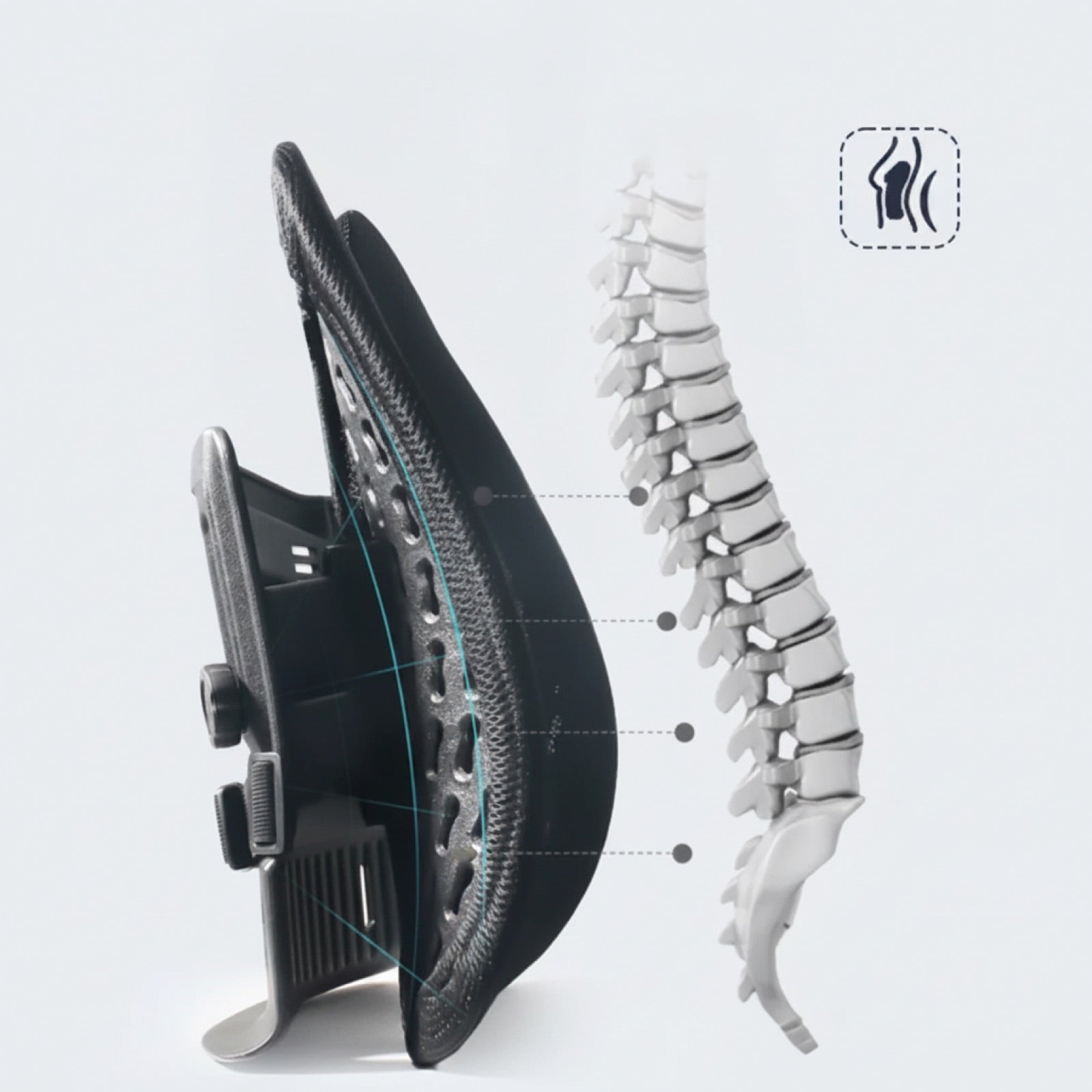
- 1 Apex sets to your curveFour locked positions
- 2 Open centre channelNothing presses on the spine
- 3 Twin wings flex independentlyEach side loads separately
- 4 4.3 in (11 cm)At the deepest point
Loosen, slide, lock. About four seconds.
No tools, no screws, no returning it because the apex is an inch too high. Loosen the knob, slide the panel to one of four positions on the rail, tighten. The rail is slotted, so it holds the position you picked instead of drifting down the first time you shift your weight.
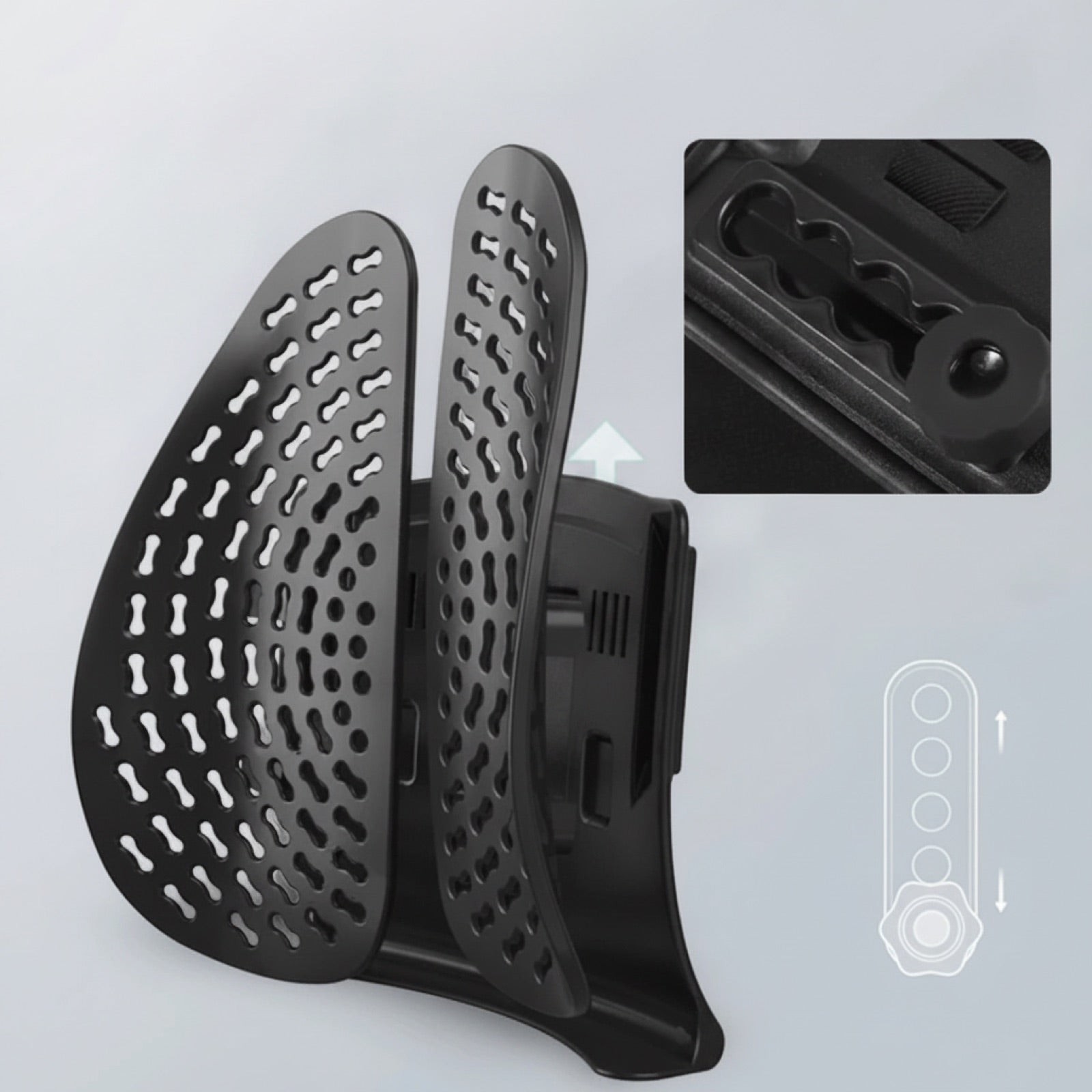
- 1 Tool free knob
- 2 Slotted railLocks at each position
- Loosen the knob
- Slide to position
- Lock
Get it wrong on day one and it is a four second fix, not a return.
Who it is for
Four situations where the height matters more than the cushion.
You sit six to nine hours a day
The ache is not from one bad moment, it is from four hundred small ones. Support that lands correctly is something you stop noticing, which is the point.
You have a short torso, or a long one
Most backrests are built to one curve. If yours peaks higher or lower than average, every fixed cushion you have tried has been in the wrong place by an inch or two, and an inch is the whole difference.
You already own a good chair
Plenty of people with an expensive chair still strap something to the backrest, because the built in lumbar maxes out too low or sits too high even at its lowest setting. This does not replace your chair, it corrects where it lands.
You are between the desk and the car
Two hours in traffic undoes a good day at the desk. The strap and quick release buckle move it between seats in a few seconds, which is also why the two pack exists.
Three numbers that decide whether a cushion works.
4 1
locked height positions, adjusted by hand in about four seconds
4.3 in 2
at the deepest point (11 cm), so your upper back still reaches the chair
0 3
foam core. A perforated polymer shell, ventilated across the whole surface
- 1. Four position slotted rail with a tool free locking knob.
- 2. Measured at the apex. Full dimensions 15.7 x 16.1 x 4.3 in (40 x 41 x 11 cm).
- 3. Twin independently flexing wings over an open centre channel. Nothing to compress flat, nothing to trap heat.
Where it works, and where it does not.
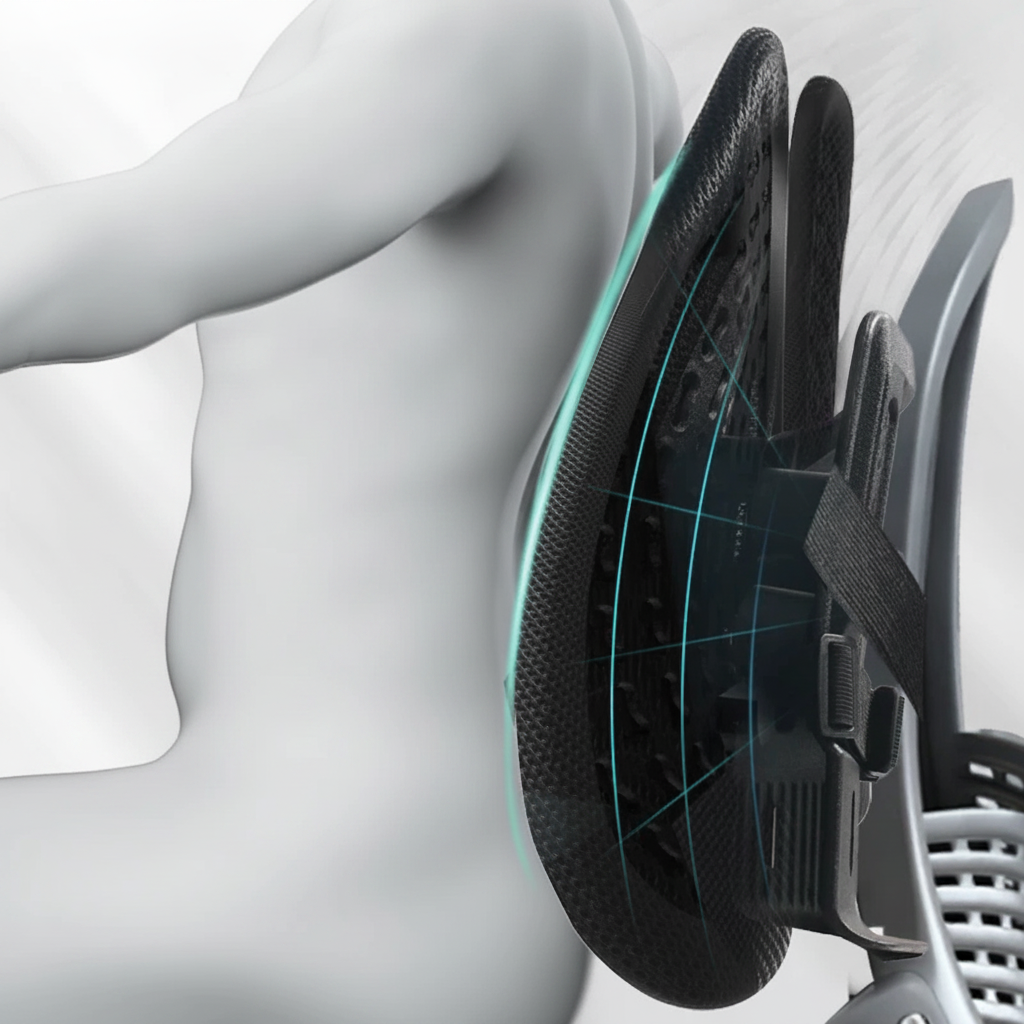
The strap runs around the backrest and closes with a quick release buckle, so it sits against the chair rather than balancing on it. Two things decide whether it fits: whether the strap can get around your backrest, and whether you have room to give up 4.3 inches (11 cm) of seat depth.
Measure before you order
If it turns out not to fit your chair, that is what the 90 nights are for. Return shipping is on us.
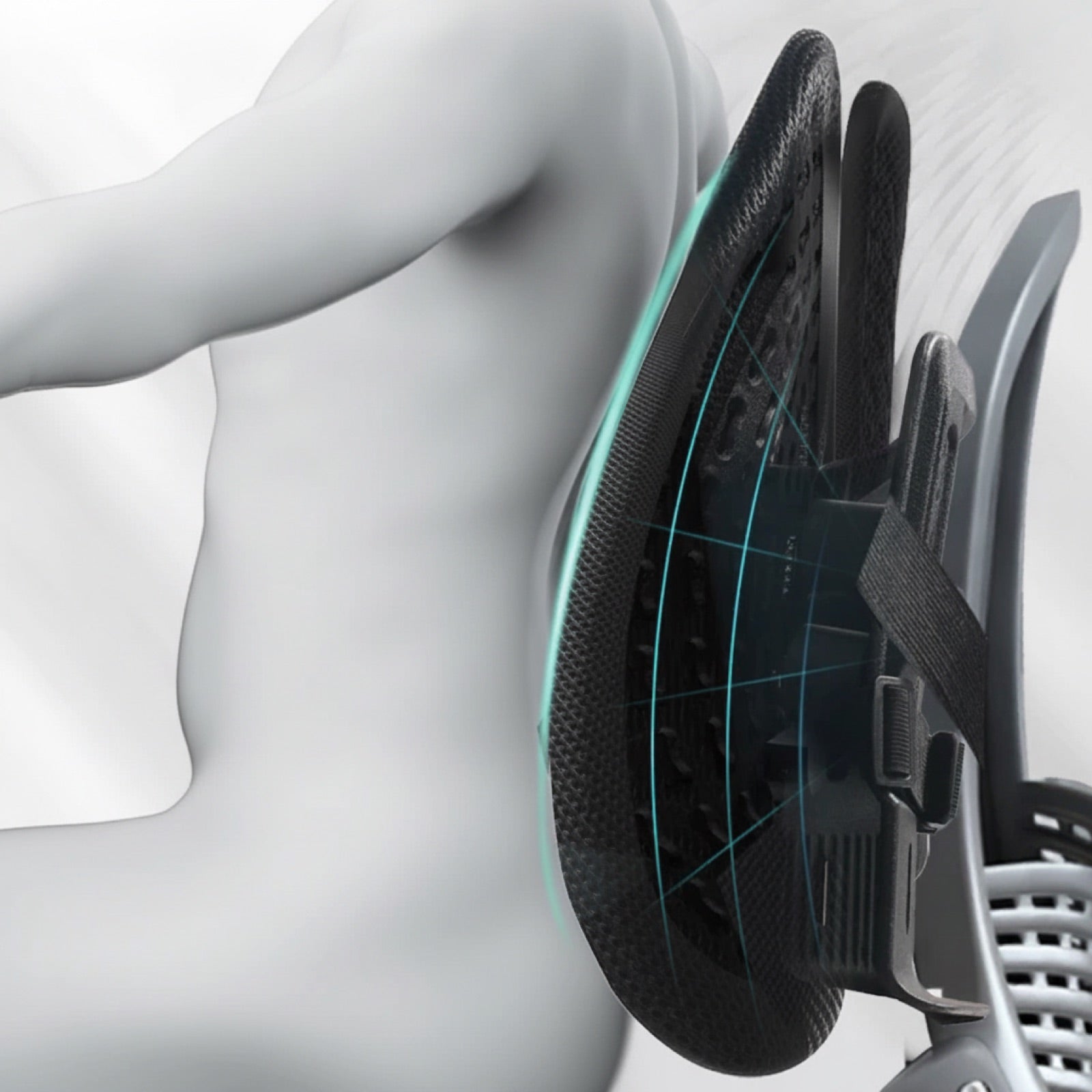
Works with
- Mesh task chairs
- Padded office and executive chairs
- Gaming chairs with a fixed lumbar bump
- Most car seats
- Dining and kitchen chairs with an open backrest
Be careful with
- Chairs with a very deep seat panAdding 4.3 inches (11 cm) at your lower back moves you forward by the same amount.
- Backrests wider than the strap can reachMeasure the circumference of your backrest before ordering.
- Full wraparound or shell back seatsA strap cannot pass behind the backrest.
- Sofas and armchairsIt will sit there, but nothing holds it in place.
A shell, not a pillow.
Nearly every complaint about a lumbar cushion is a complaint about foam. It is too soft on day one, or it is flat by month six, or it is a sealed block that sits against your back and gets warm. This is not that. It is a rigid perforated polymer shell, perforated across the whole surface, with two wings that flex independently and an open channel down the middle.
Perforation
Perforated shell. Ventilated across the full surface, not a cooling panel added to one side.
Wing junction
Twin independent wings. Each side flexes separately, so shifting your weight does not move the whole panel.
Knob and rail
Tool free knob on a slotted rail. Four positions. No screws, no hex key.
Firm, not hard. Firm is what people ask for in reviews. Hard is what they return.
Against a $22 cushion, and against a new chair.
The honest version, including the row where the new chair wins.
| Uprite, $79 | Typical foam cushion, $20 to $35 | New ergonomic chair, $400 to $1,200 | |
|---|---|---|---|
| Apex height | 4 locked positions | Fixed | Adjustable on some models, and it still maxes out too high or too low for many people |
| Depth at the apex | 4.3 in (11 cm), published | Often 4 to 5 in, rarely published | Built into the backrest |
| Holds position | Strap with quick release buckle, on a slotted rail | Elastic strap, slides down | Fixed to the chair |
| Ventilation | Perforated across the full shell | Sealed foam block | Varies |
| Works on the chair you own | Yes | Yes | No, it replaces it |
| Moves to the car | Yes | Yes | No |
| Cost | $79 | $20 to $35 | $400 to $1,200 |
A new chair is a better answer if the chair itself is broken. If the chair is fine and the support is in the wrong place, replacing the chair is an expensive way to move a curve two inches.
Four position height adjustment, adjustable strap with a quick release buckle, 15.7 x 16.1 x 4.3 in (40 x 41 x 11 cm).
90 night trial. Free return shipping. Lifetime replacement. Ships flat and pre aired, never vacuum rolled.
Questions
The six questions we actually get asked.
How do I know it will land in the right place on my back?
You do not, not on day one, and any brand that tells you otherwise is guessing about your torso. That is what the four positions and the 90 nights are for. Start at position two, sit for a day, and if the support feels like it is up near your ribs or down on your pelvis, move it one position and sit for another day.
Is it going to push me forward like the last one did?
It is 4.3 inches (11 cm) at the deepest point, and we publish that number because most of the category does not. If you have a deep seat pan, that 4.3 inches comes out of your seat depth. The Pro adds pneumatic depth control for exactly this reason: let air out until your upper back reaches the backrest again.
Will it slide down the chair?
The strap goes around the backrest and closes with a quick release buckle, and the height panel locks into a slotted rail rather than resting on friction. It is not an elastic loop over the top of the chair.
Does it get hot?
There is no foam core. The shell is perforated across its whole surface and there is an open channel down the centre, so it does not sit against your back as a sealed block.
Should I just buy a better chair instead?
If your chair is genuinely worn out, yes, buy a chair. If your chair is fine and the lumbar support is landing in the wrong place, a new chair is a $400 to $1,200 way to move a curve two inches, and plenty of people who own a very good chair still strap something to the backrest.
What if it does not work for me?
Ninety nights, and return shipping is on us. Give it two full weeks first. The first few days of being held in a position your back has not been held in for years feel like too much, and that sensation is the most common reason people return a support in week one and the most common thing they regret in month three.